Staff Education
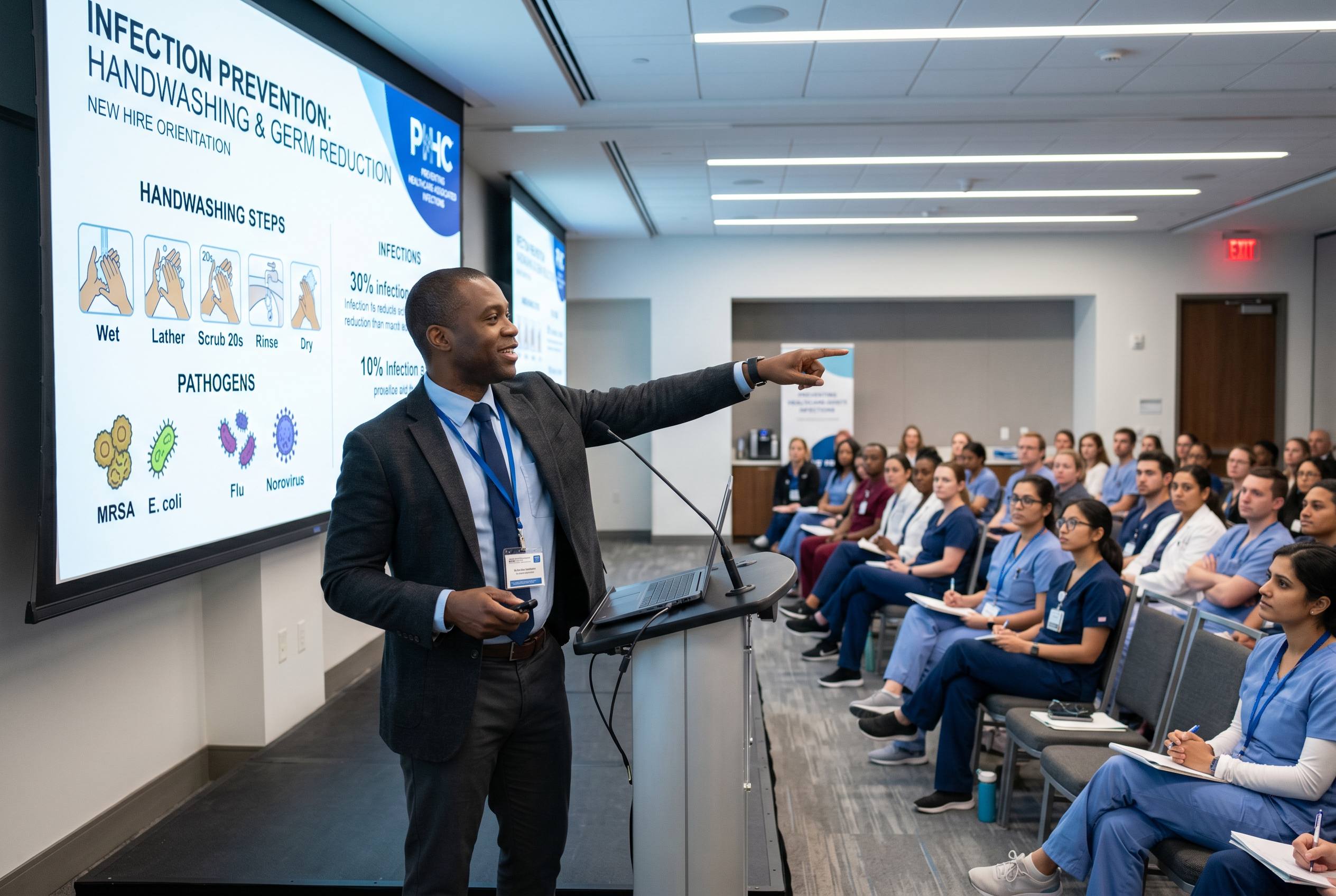
Ongoing education for nurses, aides, EVS staff, and volunteers on hand hygiene, PPE, isolation precautions, and evidence-based infection control practices.
Applied infection-prevention leadership that helps your team interrupt pathogen transmission, strengthen everyday practice, and remain prepared for CMS surveys and Medicare and Medicaid participation requirements.
Beyond cleaning, Spectrum provides a designated Infection Preventionist on behalf of your facility. This professional brings the expertise, knowledge, and practical understanding of applied infection prevention needed to educate staff, deliver training sessions, lead surveillance, conduct audits, and coordinate outbreak response. For CMS-participating skilled nursing and long-term care facilities—especially those accepting Medicare or Medicaid—having qualified infection prevention personnel is mandatory and essential to maintaining compliance, survey readiness, and the safety of patients, residents, and staff.
Ongoing education for nurses, aides, EVS staff, and volunteers on hand hygiene, PPE, isolation precautions, and evidence-based infection control practices.
Structured, facility-wide training sessions and in-services—onboarding, annual competencies, and targeted refreshers whenever protocols or regulations change.
Active surveillance of healthcare-acquired and community-acquired infections, tracking trends across units to catch problems before they escalate.
Regular rounds, audits, and observations across every department to verify compliance and identify gaps in real time.
Management of facility immunization programs and rapid, coordinated outbreak response and containment when infections are identified.
Keeping your facility aligned with CDC, CMS, OSHA, IDPH, and NHSN reporting requirements so you stay survey-ready and audit-proof.
Your designated Infection Preventionist turns written policy into practical habits. Education is adapted to your care setting, patient and resident population, identified risks, surveillance findings, and the responsibilities of clinical, administrative, and EVS personnel.
Recognizing contact, droplet, airborne, bloodborne, foodborne, and environmental routes of transmission—and breaking the chain of infection at each point.
Correct handwashing and alcohol-based hand-rub technique, appropriate moments for hand hygiene, cough etiquette, and practical compliance observation.
Selecting, putting on, removing, and disposing of gloves, gowns, masks, respirators, and eye protection without contaminating staff or surrounding surfaces.
Applying Standard, Contact, Droplet, and Airborne Precautions, isolation signage, resident placement, cohorting, and safe movement through the facility.
High-touch surface priorities, terminal cleaning, EPA-registered disinfectants, required wet-contact times, equipment cleaning, and verification of completed work.
Exposure prevention, safe sharps practices, regulated waste handling, post-exposure response, and OSHA-aligned Bloodborne Pathogens procedures.
Monitoring symptoms, lab findings, infection trends, antibiotic use, and clusters so MRSA, C. difficile, VRE, norovirus, influenza, COVID-19, and other threats are recognized early.
Case identification, line lists, isolation and cohorting, exposure communication, enhanced disinfection, reporting, and after-action review during an outbreak.
Vaccination programs, illness reporting, work restrictions, exposure follow-up, return-to-work criteria, and protection of both healthcare personnel and patients.
Supporting appropriate antibiotic use, reducing resistance pressure, and coordinating infection surveillance with prescribers, nursing leaders, pharmacy, and laboratories.
For applicable CMS-participating facilities, qualified infection prevention personnel are mandatory—not optional. Spectrum provides that designated expertise on your behalf while strengthening patient and resident safety, regulatory compliance, and survey readiness.
CMS requires Medicare- and Medicaid-participating skilled nursing and long-term care facilities to designate qualified infection prevention personnel. Spectrum can fulfill this designation on your facility’s behalf, helping reduce the risk of citations, penalties, and survey deficiencies.
A designated IP is accountable for decreasing the incidence and transmission of infectious diseases between patients, residents, staff, visitors, and the community.
Our preventionists hold primary training in clinical science, microbiology, or epidemiology and complete IDPH-approved specialized training in infection prevention and control.